The Collective Body Collective Imagination and Social Imagination - Somatics, Relationships and Entanglements

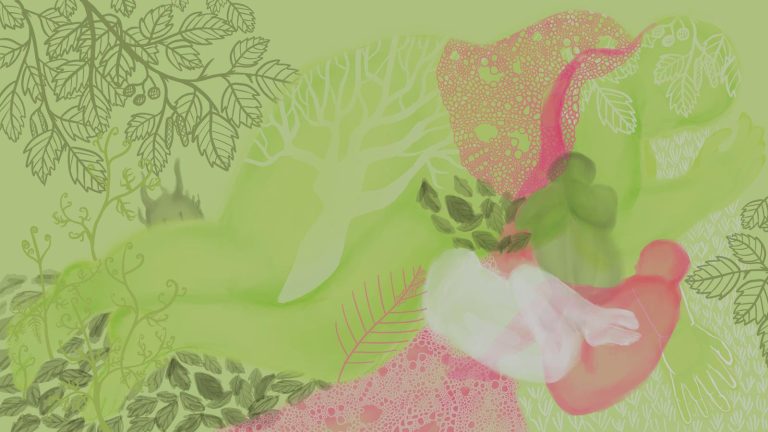
The work of imagination might most often be associated with the mind, but the following practices are intended to connect us to the essential wisdoms and intelligences of the body, and the environments and relationships that our bodies are entangled with. This work is crucial as we emerge from the ongoing Covid-19 pandemic, a time of great reckoning not only with our bodies, but with the social infrastructure that is intended to care for them.
Visit the somatic practice offered by Christa Cicciole that encourages us to consider all the ways in which we might fruitfully experiment with our personal boundaries or – as she calls them – ‘membranes.’ Play with Vanessa Reid’s audio guide that supports leaders to work with uncertainty through connecting with the creatures of our imaginations. Then use Camille Barton’s audio embodiment practice to touch in with the grief that we store in our beings, that might obstruct the work of imagination. Then
Membranes and Entanglement
Tool: Somatic exercise with audio guide
Duration: ~ 10-15 mins
Contributor: Christa Cicciole is a Berlin-based Body Oriented Systems Therapist and Consultant for Embodied Leadership. She weaves her background as a dancer, choreographer, and social activist combined with her spiritual practice, into an approach she has coined “Radical Presence: moving with playful compassion”. With her work she supports organisations and communities in order to strengthen resilience and systemic social impact.
This exercise is derived from the work and inspired by the rich conversations with Somatic Activist and Ecosomatic pioneer, Satu Palokangas.
She says that the paradox of an entangled life is that it requires boundaries, such as cell membranes, in order to foster both connection and separation. ‘Membranes delineate the boundaries of individual cells, safeguarding their internal environment while at the same time allowing measured exchanges with the external world. Membranes serve as conduits for communication and cooperation among cells, facilitating the emergence of complex biological networks. Because of membranes, life’s myriad shapes can form.”
In other words, as writer and founder of the Embodiment Institute, Prentis Hemphill, says: “Boundaries are the distance in which I can love you and me simultaneously”.
There is a beauty in our interconnectedness with human and beyond human life on this planet. Yet, just like the wisdom of our skin and cells, there needs to be a membrane that has the ability to discern responses to “the other”, such as: what is needed now and how much? What is needed to be let in to nourish, or what is harmful and needs to stay out? Or where can there be contact with “others” in order to be stronger? Membranes are adaptable and negotiating sense-making tools to measure ourselves in their environment. Just as with skin, or the surface of plants, boundaries are required for interconnection. In order to be in connection with full capacity to respond, we need to acknowledge and address the personal and collective wounds we carry. Trauma can wound the integrity of a membrane, causing separation (a strong boundary) or overwhelm (minimal boundary). This can be why we are seeing a crisis in present day mental health or the collapse of human connection with nature. On the other hand, when we can respond in the present, and not with a reaction of a learned reflex from the past, there is an increase in agency and capacity to connect and function with other systems.
With this simple experiment, one can practise navigating the world with more agency. By having access to states of a “membrane awareness” we can have a discerning sense of self awareness, be with other people’s pain and potentially minimise our distress that is often transferred when in connection with others, “take in” what nourishes our soul, and show up in the world in an embodied way.
This inquiry can be done alone, in a busy space or with another person that feels safe enough to give this a try with. Since many people have suffered from their boundaries being crossed, I would recommend first exploring these states of awareness in a space that you feel supported and held in.
Instead of the usual concept of “boundaries” being either there or not, or having to defend with a lot of effort, this is an offer to explore membranes in a more nuanced way. Since we are human, there is no way to just be in one state at a time. This is a practice of focussing for a moment on one direction of your awareness at a time. All these states are needed and useful contextually. Because of past experiences, it is possible to lose access to shift into a particular state. This can feel harmful and/or can endanger our safety in particular situations. By spending time building your awareness to each state, there can be increased access to the intention of the membrane that is needed in any particular moment.
The four states are: Inside in, Outside out, Outside in, Inside out.

- Inside in keeps your inner world inside. It is a boundary that blends out the outside world. It is, for example, what happens in deep contemplation, where one’s awareness is focused on one’s inner world.
- Outside out is the choice to keep the outside world outside. It is the attention one might have when sitting in the metro: fully aware of the surroundings and with strong boundaries from the “energy” of those around oneself. There is a sense of being in a protective bubble.
- Outside in is the ability to allow the outside world inside to your inner being. It is a state in which we can “take in” what we are experiencing. This can be nourishing to sense the connection to others, nature, places, etc. This felt sense can run deep and remind us of being connected and belonging in the world.
Inside out is the state in which the inner world can be expressed to the outside. It is when, for example, one feels safe enough to share their grief with someone and be seen in their whole humanity.
Exercise
Find a comfortable space that you can be in for at least five minutes.
Ask yourself what it feels like to be in your body right now?
Go through each state. Make use of what you are connected to (the floor, chair, etc) to represent the “outside” and imagine your inner world or “felt sense” that no one can see as the “inside”. If this is challenging to for you to access your awareness of, then put a blanket on the floor and stand or sit in the middle of it. Then imagine the “outside” is everything not on the blanket. Everything “inside” is on the blanket. Stay at least a minute in each state to sense how that boundary feels for you. Is it difficult to imagine? Does it feel safe in that state? Is it easy to shift in and out of different states?
If you feel comfortable experimenting alone, what about experimenting in an interpersonal setting? Maybe there is a person you can experiment with? Or perhaps you could try it out in every-day kind of situations without anyone knowing. For example, you could be sitting on a park bench and go through all four states. How do you connect to your surroundings with the most ease? What is the most challenging for you? How do people or animals react to you in one state or the other? I’ve practised this in crowded trains or long lines at the grocery store many times. I’ve noticed when I have a strong sense of “outside out” people tend to stay farther away from me. When I can shift into “outside in” after a busy day and focus my awareness into the stories my teens are telling me from their day, it not only fills me up with joy, I have noticed that they tend to stay longer in communication with me. Which anyone with teenagers knows is difficult to come by!
After you have spent some time with this inquiry, write your experience down. What was challenging? Where do you know this challenge in your life? Where do you know yourself to be skilled in each boundary? Which state supported ease in your body? Where can you practise these boundaries in your every day life?
Creaturely Portals
embodied imaginings for uncertain times
Tool: Audio embodiment practice
Duration: ~ 30 mins
Contributor: To fill
Preparation:
- Have a pen and paper ready
- Find a quiet place to sit or lie down
- This can be done in a pair or small group
Audio Transcript:
Hello and Welcome, it’s Vanessa here - you’re listening to my voice and I will be guiding you.
Find a comfortable or quiet-enough spot. This is going to work best if you have a pen and paper nearby as we will jot a few things down and put them aside.
Feel free to pause the audio and come back to it when you are ready.
Think about something that has been challenging or unknown for you in your work, in your leadership, or another context.
Something you would like to have some guidance for.
It should be a question to which you do not have the answer, or a situation that has you stuck or anxious.
A question you have, something you’re struggling with, where there is confusion, overload, conflict. Anything that is coming up for you right now.
Make a note of it. You can put it in point form. And once you’ve done that just put it aside.
Take a breath, get yourself comfortable.
Now close your eyes or shift your focus so that you are not looking outward, but your attention is inward. We will spend a moment in your interior landscape.
We are going on an exploration, what we might call an inner work journey.
So, sitting or lying down comfortably, close your eyes or shift your gaze - and open your listening.
Follow my voice.
Imagine a landscape of great uncertainty – it could be a space you know well like your office or a place on earth. It could be further in the cosmos, or from a story or myth. It is a situation of massive uncertainty, discomfort, or possibly chaos. It could be Real, or imagined…someplace where things feel very uncertain.
What does it look like? What does it feel like? What do you hear? Who else is there? What or who else is around? What is happening? Be curious –
Are there colours, and if so what are they…if there are sounds, what sounds are here… get a really good feeling for this landscape. And notice how does your body feel?
Now, imagine, Who or what would be at home there?
For who or what would this be the perfect environment?
What would thrive in this forest fire, this void, this space of uncertainty?
What comes to mind right away? A mythic creature? A character from a story? Someone you deeply admire or fear? A part of nature?
Imagine how this space existed just for them!
Take a moment and really see that creature, see its details. If it moves notice how it moves, if it has a texture or colour, what is its texture, if it has a sound hear that sound, you could even make that sound,
And now think about why it thrives there?
How does it get to thrive in that environment?
What gifts or skills does it have that allow it to thrive there?
Go into the details of how that object, thing, creature or person gets to thrive in that level of uncertainty.
Write down the qualities of how does it get to succeed in this, your Uncertainty Landscape?
Make a gesture or posture that represents that thriving thing….
Get to know it in your body, find its posture or make a gesture or facial expression, or all of the above! Really embody that gesture. Become it.
Let it alter you a bit. How does that feel?
Now ask:
What is the wisdom of that thing?
How can I see that quality in myself?
Can you feel how you could become more like that in your life?
In becoming more like that, notice what you become free of, what you get to let go of?
And in becoming that, what do you get to become more of?
Can you feel what you can let go of in becoming more like that?
As you experience that - go back to that earliest question, see what tip it brings to you.
How does this experience answer or offer something to that question?
How does it offer you something about navigating uncertainty?
Make some notes…
Give your creature a name.
Make a gesture to remind you of this capacity you have.
What is one quality that you want to nurture and give attention to to help you navigate uncertainty?
What could be a next step for you – the very smallest thing.
***
If you are in a Dyad/ Pair, come together to hear from each other and further embody your uncertainty ally through sharing and witnessing:
- Show your gesture or form, and describe its qualities to your partners.
- Share with your partners the tip it gave you and how this might help you navigate the uncertainty landscape(s) in which you are living or working.
- What are you now curious about?
Being with Grief to Imagine New Worlds
Tool: Audio embodiment practice and guided meditation
Duration: ~ 15 mins
Contributor: Camille Barton is a social imagineer who operates as a catalyst for social change, dedicated to creating networks of care and liveable futures. Camille works as an artist, facilitator, consultant and curator across the realms of embodied social justice, grief, pleasure and drug policy.
Context
In this time of political uncertainty, many of us are striving to create infrastructure and ways of being that will generate more care, compassion and equity in the collective. However, it can be a struggle to imagine something beyond the extractive dynamics of Capitalism and the daily realities we inhabit. Mark Fisher wrote about this phenomenon in his book Capitalist Realism, in which he claimed that it is easier for most people to imagine the end of the world, than the end of Capitalism. With the COVID-19 pandemic, the world changed overnight for many, so perhaps our ability to imagine large scale change is also in flux.
Many social change theorists argue that reclaiming and exploring the wild, creative power of our imaginations is a necessary first step in being able to vision and create more beautiful futures.
I believe that we are in an imagination battle, and almost everything about how we orient toward our bodies is shaped by fearful imaginations. Imaginations that fear Blackness, brownness, fatness, queerness, disability, difference. Our radical imagination is a tool for decolonization, for reclaiming our right to shape our lived reality ― adrienne maree brown
How can we reclaim our imagination? Cultivate it as a tool? Arguably this is a practice, not a one time event. One strategy that may be a useful starting point, is first being with any grief that gets in the way of imagining something better than this moment. Grief is not limited to the death of a loved one, we can grieve our homelands, the loss of former versions of ourselves or the pain of war and violence. Untended grief can linger, smothering our creative capacity and ability to vision, until we give it space to be acknowledged. This exercise will hopefully support you to touch into any grief that may be present when you try to imagine beautiful futures. After the practice, you can then decide how you want to be in relationship to what arises.
Lineage
This exercise is inspired by Embodied Social Change workshops that I developed using partner work and body awareness practices to explore socially engaged topics. My approach to embodiment work is rooted in mindfulness, The Resilience Toolkit, Generative Somatics and the politicised somatics space more broadly. To access tools to process grief, or learn more about my approach to this work, you can read my book, Tending Grief: Embodied Rituals for Holding Our Sorrow and Growing Cultures of Care in Community.
Exercise
1. Find a comfortable position, such as being seated or lying down.
- Play this audio recording (13.5 minutes). [LINK HERE] This will guide you through an embodied resourcing practice and guided meditation.
- After listening to the recording you are invited to journal or draw for five minutes to reflect on anything you noticed during the practice. Suggested prompt: What are the obstructions that get in the way of you imagining more beautiful futures?
4. You can finish by having a discussion in pairs or as a group for ten minutes, about your experience with the practice and how, if at all, grief impacts your ability to imagine more beautiful futures? Suggested prompts: How would you feel about using grief practices to tend to the obstructions, in order to cultivate a more radical imagination? What are some of the features of the more beautiful future that you are trying to create?