Preparing
More than Human Ecological Imagination

In times of ecological crisis, biodiversity loss, and climate change, these practices support us to draw from the expansiveness of planetary intelligences.
What might it mean, as Superflux suggest in their manifesto, to learn from the flora and fauna around us – how they grow, improvise, and collaborate – in order to inform the way that we work towards a new and better world? What might it mean, as Furtherfield and Sympoieses suggest, to learn from our more-than-human kin, resisting human exceptionalism in order to imagine and create a world that is equitable and just for all beings. For what is the work of ‘collective imagination’ if it does not take into account the full collective, human or not?
A More Than Human Manifesto
Tool: A manifesto
Duration: ~ 5 mins
Contributors: Founded by Anab Jain and Jon Ardern, Superflux creates worlds, stories and guiding visions that provoke and inspire us to engage with the precarity of our rapidly changing world. For its fifteen years of contribution to speculative and futures design with a committed social mission, Superflux received the Design Studio of the Year Award in 2021.
We are more than human. We know where we are.
Our actions have caused disastrous imbalances. The Earth’s climate system is in peril: animal populations destroyed, soil degraded. People alive today will witness the extinction of thousands, if not millions, of species.
But this isn't just an abstract tragedy happening to other lifeforms. Our fates, it turns out, are more interwoven than our predecessors knew. Without our kin – butterflies, birds, bees, lichen – humanity can not survive on earth.
That’s why we’re calling time on human exceptionalism. It’s not working for the planet. It’s not working for humanity. We believe that humankind needs to think beyond itself.
We need to remember that we are not just on this Earth: we are of this Earth. The interdependence is real: humanity as ecology, ecology as humanity. Both the head and the heart demand this mental leap, this act of surrender.
The awe of small things helps: the morning bird song; the smell of rain; the winter sunset. We need to cultivate a reverence for the beauty and embodied intelligence of our ecosystem. We need to feel that its intelligence may be greater than ours.
No more treating nature as a resource for extraction, exploitation and consumption. There is no nourishment here. Instead, we must foster mutual admiration and respect.
This more-than-human spirit will encourage us to forge new relationships with the species we share our planet with. Stripping an ecosystem for our "needs" must become as aberrant to us as cutting a piece of your flesh off to feed yourself.
Real change – more-than-human change – is possible.
For those schooled in a dichotomy between "humanity" and "nature", we will need to change how we think. This will be hard. We will need a renewal of our beliefs, of what we value or think of as "good". New taboos, too. We will rediscover old stories, stories that, though muted by the norms of an extractive capitalism, have never gone away.
But where there is life, hope remains. We can pair incredible power with humility and care, foresight with stewardship. Real change – more-than-human change – is possible.
We need to move. Here’s how:
Move from fixing to caring
Let’s move away from the techno-deterministic pull of the language around "fixing". When we foreground the idea of care, it inherently embodies ideas of fixing, building, making and everything necessary to take care of that particular thing, person, tree, insect, bird, animal, us, them, everyone.
Move from planning to gardening
Modernism’s most spectacular failures have happened when a belief in top-down planning crashes into the messy complexities of life. We should swap set squares for gardening gloves: we need to nurture and grow, adapt to rather than impose on.
Move from systems to assemblages, from knots to nodes
Acknowledging the entanglements without the desire to have the "full overview", keeps us open to surprising possibilities. And it reflects the deeply entangled co-evolution of humans and non-humans – think wolves, men and dogs, or the soil as a living organism.
Move from innovation to resurgence
After a forest fire, seedlings sprout in the ashes, and, with time, another forest may grow up in the burn. The regrowing forest is an example of what we are calling resurgence. Whereas "innovation" fixates on the new and the different, resurgence forges assemblages of multispecies livability in the midst of disturbance.
Move from independence to interdependence
We value and celebrate independence, from the first steps a baby takes to the geopolitical decisions we make. What if, instead of independence, instead of constantly valuing individual success, we celebrate our interdependence with each other and all species?
Move from extinction to precarity
Rather than retreat from the anxiety of a singular, apocalyptic endpoint such as extinction, could we instead consider the possibility of precarious flourishing?
Further Resources:
More Than Human Live Action Roleplay
Tool: A guide to more-than-human live action roleplay and a guided meditation
Duration: ~30 mins - several days!
Contributors: Lara Houston and Ruth Catlow from Furtherfield, a gallery that connects people to new ideas, critical thinking and imaginative possibilities for art, technology and the world around us. Through artworks, labs and debate people from all walks of life explore today’s important questions.
Watch Azul Carolina Duque from GTDF talk us through their social cartography, The House That Modernity Built. Feel free to explore the text and recommended resources below if you would like to explore further.
Explanation
Live Action Role Play games (LARPs) involve the collaborative co-creation of a shared imaginary world, using improvisational techniques. LARPs have a long history, with many different traditions. What’s different about a more-than-human role-play is that it invites people to imagine and then inhabit the character of another living being, such as grass, geese, bees or stag beetles.
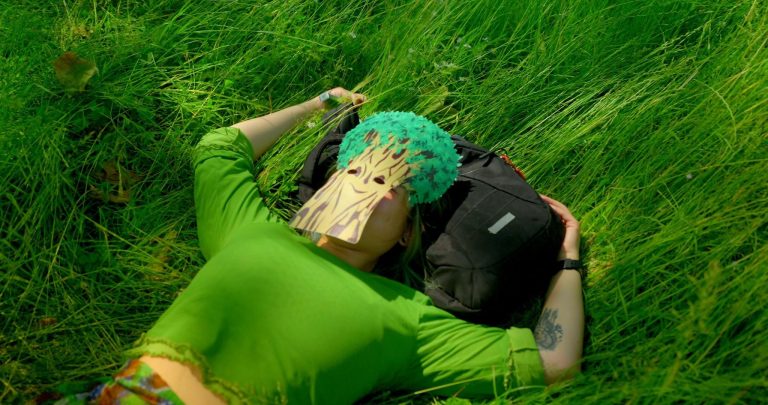
Image: Film still from a meditation. Part of The Interspecies Festival of Finsbury Park 2023 by Tracy Kiryango. Courtesy of Furtherfield.
A scenario
A LARP generally starts with a particular scenario. Sometimes these can be really specific, responding to the characteristics or urgencies of a particular time and place, like the five-year Treaty of Finsbury Park 2025 project described below. However, they can also be very straightforward, such as this Interspecies Meditation, a 30-minute guided body-scan that helps listeners to imagine themselves in a more-than-human body, also created as part of Treaty.
This 30 minute guided body-scan meditation can be practised alone or with others to build empathy pathways to other life forms. We use our imaginations and a bonding ritual to enter the body and consciousness of a different species and to reflect on the nature of their existence. This ritual transports us to the interspecies multiverse where we sit for a guided meditation.
More-than-human characters
In preparation for a more-than-human LARP, players are invited to choose, or are matched with a character who has some stake in the scenario. They are then supported to add depth and detail. If a player is to become a bee, they might ask themselves: what do bees do all day? What matters most to me as a bee? What job do I undertake in the hive? What motivates me, and what challenges do I face? Which other species do I interact with most, and how? This process aims to sensitise human players to the lives of other species.
A co-created world
When the role-play begins, each participant stays in character throughout. Unlike a scripted theatre play, LARPs involved shared improvisation. Players interact and improvise in response to a scenario to build up a shared world. Through conversation, problem solving, and a variety of group activities they bring a new imaginary set of relations into existence. They use humour and irony to deal with the obvious limitations of role-playing as another species.
There is a limit to what humans can really know about what it’s like to be a bee. Yet trying–and failing–together involves learning about more-than-human lives, and creates new forms of interspecies intimacy and empathy pathways that would not have existed otherwise. By decentering their human selves they start to perceive new dimensions of social and material reality beyond the limits of human sense perception. LARPing is therefore a powerful prefigurative practice - for rehearsing for the worlds we wish for.
Our example - The Treaty of Finsbury Park
The Treaty of Finsbury Park 2025 is an immersive fiction created in response to the 2019 IPBES report that revealed over a million species on Earth are at risk of extinction because of human action. It invites us to take seriously questions around more-than-human democracy and looks at what it would be like if other species were to rise up and demand equal rights with humans. Like many urban parks, Finsbury Park is fraught with environmental issues from noxious gases and traffic noises to governance struggles and financial sustainability. If colonial systems of dominance and control over living beings continue, we all face an apocalypse. Yet, cities are more biodiverse than we often realise – so, what better place than a city park for humans to discover more about what role we can play in growing our understanding and promoting biodiversity where we live?
In Treaty players were matched with one of seven Mentor Species of Finsbury Park - the dogs, the bees, the squirrels, the London plane trees, the grass, the stag beetles and the Canada geese. Before events, they connected with and learned about their creaturely mentors. They were supported through costume, scenarios, and ceremony to spend games inside the mind and body of their Mentor Species – with their human self as witness to all that occurs. In this scenario this multi-species citizenry rises up and finds its political voice through a story in three episodes:
- In 2020-22 people played The Interspecies Assembly Games to plan the Interspecies Festival of Finsbury Park 2023 – an event to celebrate the drawing up of a treaty of interspecies cooperation.
- At The Interspecies Festival of Finsbury Park in 2023 all the species of the park were invited to join the Summer festival and participate in festival activities devised by players of the Interspecies Assemblies. With new perspectives they shaped proposals for a new treaty for equal rights for all species with everyone, sharing their priorities and feelings.
- By 2025 a treaty of interspecies cooperation will go on display at Furtherfield Gallery along with festival highlights and an invitation to all park users to pledge their support to bountiful biodiversity in Finsbury Park.
Interspecies LARPing allows people “not only to feel different but to feel relationships that are not ubiquitously available at present” as Ann Light, a player and researcher explains. By exploring co-creative practices while role-playing other creatures, we start to feel what it would mean to take seriously the things that matter to them. If you want to explore more-than-human LARPing you might start by choosing a Mentor Species. Seek out and spend time with individuals of this species. Commit to growing trust and respect with them, learn something about their history, or their science and cultures. Learn about what conditions support their wellbeing.
Now you are ready to play your own games of collective more-than-human make-believe.
Further resources:
Treaty of Finsbury Park website
The Algorithmic Food Justice project role-play (a precursor to Treaty), co-developed with Sara Heitlinger.
Sympoietic Self: Who We Are When We Are Other
Tool: Workshop design guide for multispecies imagination
Duration: ~30 mins - 4 hours
Contributors: Sympoiesis is the experience and design lab based in Berlin, on a mission to develop our collective response-ability to metabolise loss and regenerate living systems. Co-founded by Niels Devisscher and Rūta Žemčugovaitė.
Watch Azul Carolina Duque from GTDF talk us through their social cartography, The House That Modernity Built. Feel free to explore the text and recommended resources below if you would like to explore further.
Introduction
What: Multi-species imagination seeks to heal our experienced separation from other species. Through multi-species imagination, participants can tap into their empathic response-ability and co-create systems and practices that care about the well-being and agency of all species. We can draw upon the intelligence of nature from 3.5 billion years of R&D.
Why: Animals and plant life are often casualties of our human inventions and designs, rather than co-creators that benefit from them. This has resulted in large-scale biodiversity loss. This workshop — which includes two tools, encourages participants to take on the perspective of another species, feel what it’s like to be “other”, and speak on behalf of it. It seeks to catalyse a perception shift, away from the separation from nature and human exceptionalism towards interbeing — living and working with other species in the interest of all. We hope that such a perception shift will contribute to your story, systems, and product innovation that build towards thriving and radically inclusive futures.
For whom: This tool is for everyone. We hope these tools will inspire you to become an experience designer for your own community — whether that’s your workplace, your organization, your local community, or at a stakeholder meeting. Depending on the space, you can invite participants to move into an inquiry session focused on your specific questions or objectives of the gathering.
The Tool
The tool guides you in designing your own guided multispecies meditation and facilitating a deeper group inquiry. We offer an example script that you can follow, as well as a recorded audio meditation that you can play in your facilitated spaces.
Part 1. The meditation will allow you and your audience to disengage from a singular human perspective. It invites the participant to leave behind their human body and enter the body of another species — whether it’s a plant, animal, fungi, bacteria, mineral, or a larger ecosystem.
Part 2. After the meditation follows an inquiry in smaller groups of 3-4 persons. Participants will stay in the non-human forms. We advise asking your participants to remain in the more-than-human-being perception and bring that newly gained perspective into other planned activities for your group (such as decision-making or a design session).
This tool is particularly useful if you want to involve a larger group in the process of decision-making and enable communities and teams to represent more-than-human stakeholders, in order to invite other species to inform our decisions and take their best interest.
When to use
This is a highly versatile tool. You can use it in these instances, but not limited to:
- Before a design sprint;
- To enable more-than-human stakeholder participation;
- To enhance creative empathy and imagination in your team;
- When in need of new collaboration methods.
Part 1. Multi-Species Meditation
Context
Every place and context can inform us about the design and goal of the meditation. It can also create a more intimate experience of the place, as we engage our imagination of the species and landscape of that ecosystem, city, or bioregion. Regeneration is rooted in place, and we believe that desirable futures depend on a deep, relational engagement with local species.
Before you begin (optional): Map out the species that are residing in the area you are working with. What ecosystems, native, and exotic plants/animals/fungi live here?
Writing the meditation
Writing a meditation script is a deeply creative process. Imagine that you are writing a script for a dream that the dreamer will remember for a very long time. The dream will intuitively make sense because there will be a sequence of actions and an end result that will create a heightened emotion. This is a process of live storytelling—each participant will embark on their own transformation, yet everyone will be experiencing it collectively. Every part of the meditation is significant, and should not be overlooked or rushed. We suggest following your intuition during the design process. You know your participants best — both in their level of comfort and their openness to experience.
Having a well-defined arc of meditation will bring depth to your participants’ experience. You can use the structure we have written for you here [LINK PDF titled Meditation Arc + Multispecies Meditation Part 1]
Alternatively, you can play this multi-species meditation recording (10 min) to your audience (same as the written meditation above). [EMBED AUDIO]
Part 2. Group Inquiry
The group inquiry is meant to deepen a more-than-human experience.
- Important: Before starting, ask your participants to remain in the perception of their more-than-human being and bring that newly gained perspective into their small groups. Encourage them to speak from the first-person in “I” statements, rather than third-person “it” statements, when answering questions asked by their teammates.
- Divide your participants into groups of 3-4 depending on the size of the group.
- Each “being” will be interviewed by their members about their lifeworld. We have provided the questions below. Feel free to print them out and add your additional questions. Each person will have around 7 minutes to share as another being, from their first-person perspective.
- Once everyone has taken turns, participants can return to the big group and share their experience — what they discovered about other beings, what they found difficult, and new insights they have gained. In the big group, the facilitator can then weave the experience into a more pragmatic discussion, reflecting on how the insights can shape conversations around e.g. organisational systems and structures design, or product and service design — tapping into collective imagination and multi-species perspectives.
You can access the group questions here for printing. (LINK PDF titled Multispecies Imagination Toolkit - Inquiry Questions - Sympoises)