Preparing
Preparing the conditions Frameworks

While the work of collective imagination requires creativity, flexibility, and a good dose of mystery, it is important that we draw on the many existing structures, practices, and frameworks that can bolster our work with the scaffolding and rigour that it needs.
Play with the narrative strategy framework provided by Healing Justice London, that helps us to build the shared capacity to see, explore, and navigate shifting narratives. Then try out the Three Horizons framework, originally conceived of by Bill Sharpe and the International Futures Forum, and built on by Ingrid Burkett, that encourages us to explore ‘the collective imagination of the now.’
Unpacking, Expanding, and Imagining
Shifting Narratives
Tool: Framework
Duration: ~ 30-120 mins
Contributor: Sarah Joynt-Bowe from Healing Justice London is a communications and narrative change strategist with over 15 years of experience developing dynamic, effective work for organisations in three countries and countless sectors. She is also an active community organiser working within anti-racist, abolitionist, and feminist social movements.
The stories we tell are woven with invisible threads. Threads that connect histories, systems, geographies, cultures, and experiences. Among these threads are narratives, deeper, more penetrating ideas and themes that shape and are shaped by how we understand the world.
Healing Justice London builds the capacities, skills, and infrastructures we need to support community-centred health and healing — this includes finding ways to orient towards health, healing, and justice. This tool, designed to support strategic narrative practices, enables us to place a magnifying glass upon those threads and, for a moment, pause to explore their hidden, intangible parts. We expand, lay bare, and explore if the narrative rules we’re playing by serve our shared vision of abundant and accessible community health and healing.
We practise narrative strategy by interrogating the characters, conflicts, and levers of power that inform stories, possibilities, shared understandings, and so-called ‘common sense.’ As an organisation deeply concerned by health and healing, we’re focused on the ways that health and healing have been stripped from narratives around racial justice, disability justice, economic justice, mass-marginalisation, and dispossession.
This tool is a cheat sheet – a means of building that muscle memory. With long-term use, the user builds a natural practice of interrogation, exploration, and imagination.
Narratives shape what we believe is possible or common sense. To practise collective imagination, we need to build the muscle to see the assumptions, power dynamics, and agendas that undergird the stories we tell.
Before we begin, let’s get clear on the following questions:
What is a story? A story describes an event or sequence of events that include characters, conflict, and imagery. It has a beginning, middle and end.
What is a narrative? Narratives are the ideas and themes that permeate collections of stories. The ideas can appear in any structure, and are articulated and refined repeatedly in a variety of stories and messages (see Narrative Initiative resource below).
This activity invites you to explore the narratives that shape your work area, expand your understanding and analysis of their impact, and imagine what stories are possible outside of the dominant narrative’s assumptions and limitations. Now, explore the example below, and fill out your own.


Layering Horizons for Collective Imagination
Tool: Framework
Duration: ~ 30-120 mins
Contributor: Ingrid Burkett from the Griffith Centre for Systems Innovation in Queensland, Australia. She is a social designer, designing processes, products and knowledge that deepen social impact and facilitate social innovation.
Lineage
This tool is inspired by the Three Horizons framework developed by Bill Sharpe and the IFF. We highly recommend that you explore the resources collated here before diving in, if you are not already familiar.
In the process of exploring this framework, we played with an embodied version of it. We’ve found that experimenting with three dimensional versions of the Three Horizons has shifted ours and others’ understanding. We ‘took it off the page’ forming the horizons using different coloured ropes in which people moved around. We loved how people started to tell stories as they moved through the framework. They picked up the ropes and told of their experiences of the ‘horizons’ moving. For example, during Covid lockdowns people felt Horizon Three became more visible, angles shifted and the intersections between H1 and H3 moved closer because of necessity. Others spoke of the ‘snapping back’ that happened when lockdowns finished and the status quo of H1 reasserted itself.
People also felt that seeing beyond the ‘boundaries’ of the framework is important so that the cycles of time are recognized as both alive and continuous. As conversations got deeper there were also harder stories - about how unidimensional horizons can become, how difficult it can be to present different versions of the present let alone any futures, about whether transitions and futures would be any different for those who are already excluded from participating in positive presents.
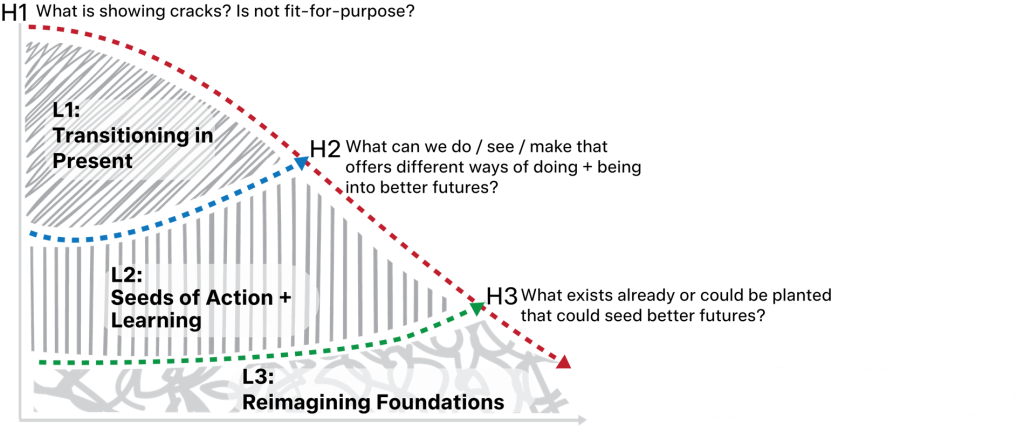
Through these experiences we have found ourselves increasingly drawn to exploring how frameworks can stimulate deeper conversations, and how we can change our perspectives, grow different stories and new possibilities for action. We see an opportunity to shift perspectives around frameworks - away from the uses we see where they are put forward as static representations of a particular perspective on reality; and towards a 'making' orientation that uses them as a canvas that helps us collectively challenge, play with, and embody different versions of the present and of possible futures. Our hypothesis is that this approach can support the deepening of collective conversations about the layers of past, present, transitions and futures within present systems. So, one idea that emerged was that this framework could be seen from both a horizontal lens (across the horizons), and a vertical lens. Bill Sharpe articulates this when he says “each horizon in effect is developing a different quality already existing in the present, and which might come to become more prominent depending on how people choose to act - to maintain the familiar or pioneer the new”. It is this lens that we find ourselves exploring more and more as we grow collective imagination practices with our communities of partners.
Explanation and Context
We often find people have a view of imagination that takes it out into the distant future - it’s described as speculative, utopian, conceptual… and really not very practical.
In workshops we have found a tension between people focusing on the present in terms of ‘what’s not working’, and then flipping towards an imaginary future, one that can feel far away, with some describing it as being in the realms of fantasy.
We think the most interesting opportunity to concentrate our collective imaginations is on what we could do, how we could be, what we could try in the present. We are keen to explore the collective imagination of the now as an ongoing set of practices to support action.
Layered (Re) imaginings of Systems using Three Horizons
What we put forward here is less ‘tool’ and more ‘framework’ for deepening collective conversations about the layers of past, present, transitions and futures within present systems. It is a framework for opening and deepening reflective practices as we act out collective imagination processes. For example, conversations about futures of ‘the’ economy are often presented as singular - but there are many economies across human history, and also many economies in the present that can be (and sometimes are) amplified or invested with more attention as models for transitions and futures.
We think a vertical lens of the Three Horizons can give us a view that allows for deeper explorations of moments in time - a viewpoint that is much more about digging into the multiple layers and teasing out the threads between them.

Focusing in on the layers within present systems provides much deeper contextual nuance through which to unpack complexities, whilst also showing where these are already offering opportunities to plant seeds for Transition Systems and/or lay foundations for Future Systems. These views may be overlapping but could be represented like this:
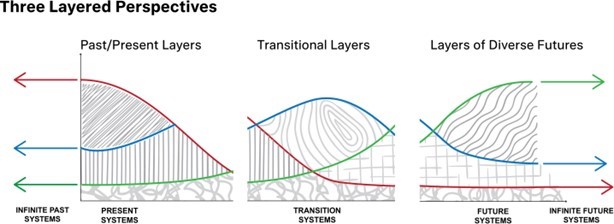
If we focus in on the first of these layered landscapes, then, we start to see the interactions between the horizons (H1-H3) and the layers (L1-L3).
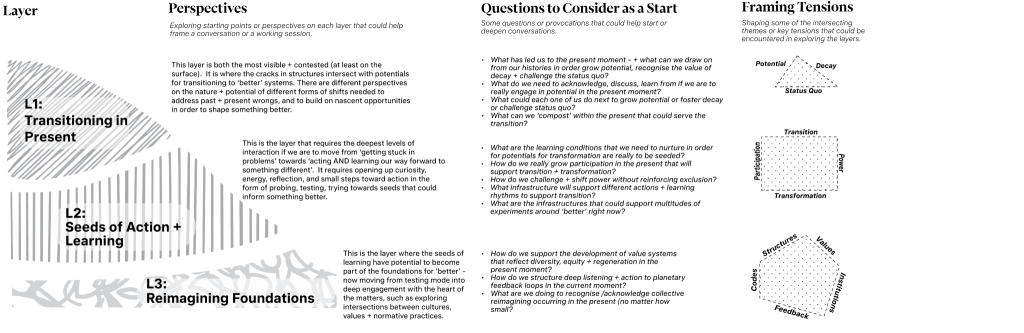
Using this layered perspective to support collective imagination conversations or workshops could be scaffolded with:
- exploring perspectives of what constitutes the ‘matter’ of the layer; or
- opening up questions that lie at the heart of each layer; or
- examining the tensions that are inherent in imagining the present through each layer.
Below we outline one way each of these scaffolds could be shaped up to support deeper collective imagination explorations.