Preparing
Time, Ancestors, and Future Generations Temporal Imagination

This section of the toolkit includes practices that remind us of the quantum nature of time, that connect us to the new and the very old, to the wisdom of our ancestors and to our care for future generations.
Visit Roman Krznaric’s slide deck and Asma Ahsan Khan’s artistic exercise to play with different perceptions of time. Use the exercises put forward by Ella Saltmarshe of the Long Time Project to connect and care for those yet to be born, as well as those who have gone before us. Or project forward into the future with New Constellations and Plurality University in order to better imagine, anticipate, and prepare for a more beautiful world. See how your goals, plans, and perspectives shift in the light of these different timelines.
Expanding Human Time Horizons
Tool: Prompt questions and a group exercise
Duration: ~15 mins - 2 hours
Contributor: Roman Krznaric is an Australian-born social philosopher, whose books focus on the power of ideas to create change. His latest book is the international bestseller The Good Ancestor: How to Think Long Term in a Short-Term World.
Organ Clock
A tool for exploring the Temporal Imagination
Tool: Creative exercise
Duration: ~30 mins - 2 hours
Contributor: Asma Ahsan Khan is a Pakistani, multidisciplinary artist settled in Montreal, Canada. Khan's practice explores complex natural systems, aiming to find spiritual symbology and a feminine sensibility in phenomena like gravity, time-space, black holes, coral ecosystems, mycelium, and neural structures. Motivated by the mysteries of the natural world, Khan combines rigorous research with intuitive drawing to reveal connections between micro and macro systems.
The materials you need
- A sheet of paper.
- Art materials - all kinds of art materials can be used - paints, pencils etc.
- It could be a collage, so if that’s your preference then you’ll need scissors, glue etc too.
The intention and purpose that sits at the roots of this activity is to know and experience that time is entropic, and that the longer and deeper we get into time, entropy increases. While entropy may create chaos, this exercise allows us to put our attention on the multiple systems that create time. By zooming out of the most common understanding of time and zooming in to smaller systems of time, we can attempt to work with the deep complexity of entropy. This particular exercise helps give agency to our senses and to our intuition and bodies. It helps us gain understanding over entropy.

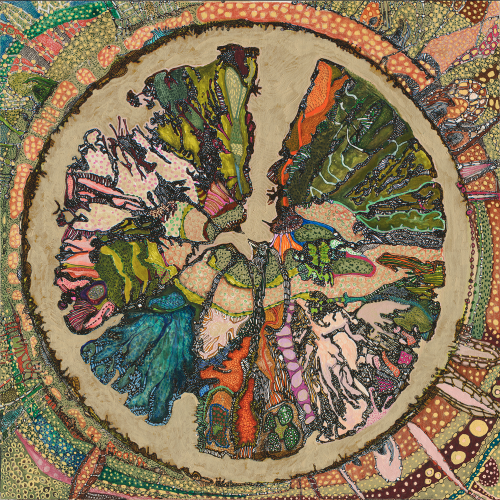
Lemon Clock by Asma Khan
It also allows us an alternative clock - of different types of time, or being in different time zones within our bodies. It gives agency to the self over the human construct of time. We don’t have a good construct of time - we are always running out of it. To play with time through this activity is an invitation through portals to explore our imaginations and come across new realisations in new ways.
Keys of imagination can help us explore…
What happens to time when it goes through water?
What happens to time when it goes through beauty?
How the witnessing of something changes the nature of time.
Time has short arcs and long arcs - if you stay with something, you get to know the long arcs of time
Time Going Through Beauty by Asma Khan
Creating the conditions for this activity
The sensory is really important for this activity, so when you create the space for it, these are some of the things you might want to consider…
What kind of lighting will take you into a different realm? We’d recommend avoiding electric light and creating your clock under daylight or candlelight…
What kind of music might you want to play, with its ability to create a different atmosphere…
What else might be in the air to smell? We’d recommend oils or sage smoke.
We’d also recommend some discomfort. It can help to defocus you from what you know and are familiar with. This might look like standing on one leg, burning so much sage that the smoke can make your eyes water, or dancing as you draw so you have less control over the lines.
If discomfort is not welcome then we’d recommend going into a meditative state through deep breathing.
Lastly, if you want to do this outdoors, and in nature, that is also an option.
Step 1
The very first part of this activity is to write down a question that you have been holding and that has overwhelmed you for a long period of time.
Step 2
As the title of the activity suggests, some of what we’re exploring are the organs of the body. Spend one minute meditating on the image below, meditating on the shape of the organs within your body.

The next part of the activity is to connect with your intuition and flow of drawing.
Initially we want to invite you to practise drawing the organs, but blindfolded, so that you let your hand know what the shape of a kidney is, what the shape of intuition is, and so forth.
Taking a sheet of paper and with a blindfold on, guided by your intuition and what feels instinctive, draw each of the organs as a shape. This is about discovering your own shape for each of them, not interpreting what a kidney or an ear or a nose looks like as we might usually see them.
Step 3
With the blindfold removed, the next part of the activity is to draw a large circle - as large as you can draw around your page. The circle needs to hold 12-15 shapes in it.
This large circle that you are drawing represents the entirety of your body, soul and spirit.
During the next part of the activity you will put 12-15 different shapes (organs) into the circle - each of them representing different emotions.
Step 4
As you go to draw each shape, a key part of the activity is to ask these prompts -
- What is the shape of your organ of envy? (or intuition, or love - you will see an order to do these in below)
- Where does the shape belong in the circle/ body? Where would you place it? Be guided as to where to place it in the circle.
- What colour and texture is the shape?
- What kind of line will you use for the mark-making? Will you draw a string line? A dotted line? A hesitant line - Use the emotion to determine what kind of line you use.
- What is the size of each shape in relation to the others? For example, is love larger than envy? So you are always thinking of each emotion, and its shape, in relation to the other emotions in your body.
- What is the position of each shape in relation to the others? For examples, Is intuition close to fear?
- After you have drawn each organ shape, write the name of the emotion underneath it.
And remember - draw very intuitively - using an intuitive drawing hand that is not led by our intellectual selves. This requires letting the hand go and thinking as little as possible - you feel, you draw, you feel, you draw. It’s a very feeling activity.
So using the prompts above, you can now draw each organ shape -
- The organ of envy
- The organ of our intuition.
- The organ of impatience and frustration
- Locate the sensory input of smell - what is your organ of smell?
- Focus on our future - imagine the last home of your life. The last moment when we die - where in your body is death located? What is the organ of death?
- The act of witnessing - the sense of Sight - locate in your body your sense of sight, its importance to you. What is the organ of sight?
- Your organs of Resignation and Sadness - where are they located in your body? What is the shape of sadness in your body?
- The organ for a sense of softness and touch
- The organ of love
- Locate the sensory input of taste - what is your organ of taste?
- The organ for our sense of sound
- The organ of fear
Step 5
Once all the organ shapes are drawn, it’s time to add numbers to your Organ Clock. Draw 12 at the top of the circle and 6 at the bottom and then 3 and then 9 - so the basic numbers of a clock. Once they are in place, fill out the rest of the numbers 1-12 around the outside circumference of the circle.
Step 6
It’s time to go back to the question that you wrote down at the very beginning of the activity.
Hold the question that has had you overwhelmed for a long time and draw a minute hand/arrow toward the emotion that most has you overwhelmed, or feels most resonant to this question.
Then intuitively, close your eyes even and with this second arrow, draw it with the non dominant hand, so it has less knowing and more intuition. which emotion on the organ clock can best help you navigate that particular feeling or emotion from the question you were holding? Point your hour arrow toward the sense that helps you navigate this emotion…and this will be your guide.
Another way to consider it is that one organ is sick in the body and the other organ is there to take care of it.
What are you feeling? Noticing? Appreciating? What has newly arisen for you? Or come into view for you?
Another detail to pay attention to is what is the time on your Organ Clock? What time do the hands on the clock read? And what new insights does this give you..?
For example… When I am 2.30pm I can hone into my sense of intuition ..
Can we allow our organs to play with another sense of time? Can we create empathy for our eyes or our liver.. Can we use the agency of our organ of intuition to guide us? At what time in the day can we provide nourishment and empathy to our organ of resignation? Which sense guides our dreams of the past and which sense drives the dreams of the future? What is the best time in the day to give love to our organ of death?
Is there a hidden hour, a 13th hour that might emerge from our Organ Clock…does the hour point to a new mysterious organ within us? If so, what does this organ do for you?
Practices to Generate Care for Future Generations
Tool: Three practices to generate care for future generations
Duration: ~5-30 mins
Contributor: Ella Saltmarshe is the co-founder and director of the Long Time Project, which exists to galvanise public imagination and collective action to help us all be good ancestors. She is the host of the Long Time Academy podcast.
Those of us alive right now hold a disproportionate amount of responsibility for the future. The actions we take now will affect the fate of billions of future inhabitants of Earth (of all species). The future is literally in our hands, and yet, most of our organisations haven’t been designed to take future generations into account.
Here, I’m sharing three short practices to help you bring care for future generations into the culture and processes of your organisations so that you can act as better ancestors.
- The Empty Chair
At meetings, leave a chair empty to represent the young and all those who have yet to be born. At the start, the meeting’s leader can recognise the empty chair as representing the needs of future generations and encourage those present to refer to the empty chair in their proceedings.
This tool helps those present to start to consider future generations in their decision-making
The Empty Chair for Future Generations practice is inspired by The Great Law of the Iroquois Confederacy which advised people to look and listen for the welfare of coming generations, “even the unborn”.
- Acknowledging the Future
Create a short statement to acknowledge future generations to use at the start of meetings or events. You can design your own or try out one of the following:
Before we start, I’d like to acknowledge that the decisions we make in this room today may have implications into the future and far beyond the lifetime of this project, team or organisation. We make those decisions with that in mind.
OR
We recognise that the actions we take today have implications for tomorrow. We acknowledge and respect the needs of today’s children and those yet to be born.
OR
As we start this work, we acknowledge the world that will exist beyond our lifetimes and the people, animals and nature that will thrive in it.
This is inspired by Acknowledgements of Country/Territory, which are demonstrations of respect for the traditional custodians of the land on which a meeting or event is being held.
- Human Layers Reflection
Take 5-10 minutes at the start of a gathering to use this reflection to enable participants to strengthen their ability to think like good ancestors. Below is a script for the exercise, feel free to adapt to suit your context. If doing remotely, encourage people to turn off their cameras to to get into comfortable position where they will not be disturbed.
We are going to do a reflective practice together over the coming minutes. Take a moment to arrive. Rest into the support of the ground beneath your feet and the space of the air above your head. Feel the breath moving in and out of you. Let your eyes slowly come to a close.
Bring to mind someone you feel warmly towards of your grandparent’s age; they may or may not still be with us. It could be a grandparent, a great aunt or uncle, or someone else of that generation. Think of one of their qualities that evokes warmth in you, it could be their smile, something that made them laugh, a funny habit they had...
In your mind’s eye, step back one step. You’re stepping back in time. Now imagine that person at 40. How was that quality that evokes warmth present in them then….? Take a moment to connect with them in the past.
Now in your mind’s eye step backwards another step. You’re stepping back to this person’s 9th birthday. How was that quality that evokes warmth in you present in them then? What do they look like? What party food are they eating? Imagine who else is there. When is it? It could be in the 1920s or 30s, or earlier… or later…?
Where are they? Imagine you walk over to the window and for a moment turn your back on the party. What do you see outside of the window? What’s the world like back then?
Now turn back into the room. Take a moment to drink in this birthday party of this person you have cared about and then take your leave.
In your mind’s eye, step forward one step through the generations, and another…
Arrive back in this moment [give the date]. Take a breath. Feel the air moving in and out of you. Let go of the image of that older person. Rest into the support of the ground beneath your feet and the space of the air above your head.
Now think of a small person you know who you feel warmly towards.
It could be a child, grandchild, niece, nephew or the offspring of friends. Think of one of their qualities that evokes warmth in you, it could be their smile, something that made them laugh, a funny habit....
In your mind’s eye, step forward one step through the generations, and imagine that person at 40. How is that quality that evokes warmth, present in them then? Take a moment to connect with them in the future…
Now step forward another step, to their 90th birthday. They are sitting around a table being celebrated by their friends and family. They are laughing. How is that quality that evokes warmth, present in them at 90?
What do they look like? What food do they love? Who might be there with them? Stay in the warmth of the party. When is it? It’s probably around the end of the century, 2090, 2095, maybe a little earlier, maybe a little later…
Imagine you walk over to the window. What do you see outside? What’s the world like in the future?
Back in the room, someone is tapping a knife on a glass, calling for everyone’s attention for a toast. You suddenly notice there’s a framed picture of you on the table. That person you care about who is celebrating their 90th birthday, asks everyone to raise their glass and toast you. They thank you for something you did that helped shape their world for the better. What are they toasting you for? Stay in that moment. Take some deep breaths to connect to your legacy.
Give them 20- 40 seconds to reflect
Now it’s time to come back. Take your leave from this party in the future. In your mind’s eye, step back one step through the generations, and another, to arrive back to the present. Take a moment to land back here. [give the date] Take a deep breath. Slowly open your eyes. Keep them low at first to let them adjust.
You’ve just time-travelled about 200 years and crossed 7 generations. How did that feel? If it feels appropriate, I invite you to bring your expanded ancestral capacity to our time together today.
I often end this exercise by inviting people to share in pairs for a few minutes each to enable them to process and connect. This exercise can leave people feeling emotional. It might be worth flagging up that people can step out before the next activity, or ask for support if they need it.
I co-created this exercise with nature-based experience designer, Hannah Smith. It is inspired by the work of deep ecologist, Joanna Macy.
Further resources:
- Use the Long Time Tools, co-designed with policymakers from across the world
- Listen to the Long Time Academy podcast
- Use this plan to run a ½ day workshop to help your organisation be a better ancestor
- Dive into the work of the School for International Futures on a intergenerational fairness policy assessment framework
- Read Coming Back to Life by Joanna Macy & Molly Brown
- Much of our work is inspired by indigenous antecedents. Dive into this via Braiding Sweetgrass by Robin Wall Kimmerer, Indigenous Wisdom for Living Spirit-Based Change by Sherri Mitchell, Sand Talk by Tyson Yunkaporta.
Bold Visions for Beautiful Futures
Tool: Guided imaginative journey to the future (audio)
Duration: ~30 mins
Contributors: Iris Andrews from New Constellations, an experimental non-profit helping people imagine and create futures of human and planetary flourishing. We take groups on immersive journeys of reflection and discovery, to examine the reality of the status quo, explore expansive possibilities for the future, and consider what true transformation will take at the levels of self, group and system.
(Audio piece made by Iris Andrews and Jo Barratt, voiced by Iris Andrews and also featuring adrienne maree brown, Angel Acosta, Audrey Tang, Farzana Khan, Hilary Cottam, Hrund Gunnsteinsdóttir and Rob Hopkins.)
This tool invites you on an imaginative journey guided through audio, to help you feel into a bold vision for a future you long for, and can orient towards. We invite you to explore this vision because we believe transformative change starts with new stories of possibility; that a first step to co-creating better futures is being able to envision and embody them. Particularly when times feel heavy and uncertain it can feel uneasy or utopian making space for positive visioning – yet how can we build a safer, fairer, more beautiful world if we can’t imagine it?
How to use this tool
- We encourage you to find a quiet space and set aside enough time to do the exercise in one sitting (~30m), and to listen with headphones for the most immersive experience. This exercise also works well for a group if it can be played out on a good quality speaker.
- Have something to write or draw with and at least six sheets of paper or a notebook with you as you listen, as you will be invited to record some of your responses should you wish to. You can of course pause the recording at any point if you want more time to sit with a question or idea.
- We hope this will be a relaxing, embodied and creative experience – something for your heart and gut (intuitive sense) perhaps more than your head. It is important to acknowledge that some people find positive visioning pleasurable and/or easy, while for others it can be challenging or bring up difficult feelings, and everything in between. All responses are valid and welcome; take care of yourself and each other and if it’s not for you at this time, that’s ok.
- This recording currently references 2030 as a future lens at some stages, but we encourage you to think as expansively and far into the future as you wish.
Creative Foresight
Inhabiting 2040
Tool: Training exercise
Duration: ~1 day
Contributors: This tool was developed by Juliette Grossmann (conception) and Juliette Lépineau (design) from the The Plurality University (U+) Network, with the close collaboration of the U+ team: Chloé Luchs, Daniel Kaplan, Ketty Steward. In partnership with Mustapha Wafra from the non-profit organization Les Petits Débrouillards. U+’s mission is to explore and open possibilities for the emergence of empowering, just and sustainable futures, by mobilising resources of the imagination (art, fiction, speculation…).
Context and objectives
Les Petits Débrouillards is a popular education NGO in France, who focus on developing critical thinking and scientific awareness for children using alternative educational methods. After going through different crises, the NGO was looking to rewrite their mission statement and strategy with their stakeholders: employees, volunteers, directors, partners, from everywhere in France. As a first step towards this goal, they wanted to experiment creative foresight in order to:
- bring together the regional branches of the association in the same exercise and strengthen the social link;
- raise the concerns and desires of all the stakeholders for the future of the structure, as well as for the future of popular education;
- encourage a sense of agency in a context of instability and general worry towards the future;
- develop different narratives to open up possibilities and imagine ways of adapting to change;
- value the knowledge and vision of every member of the association;
- find common ground, while embracing the plurality of existing visions.
Project process
We created a specific tool, a one day exercise called Aux Futurs Citoyen·nes (To The Future Citizens), and organised a two-day training in Paris with 20 employees of Les Petits Débrouillards who volunteered as Regional Representatives. The goal was to introduce them to collective creative foresight, teach them to facilitate this kind of exercise in each of their regional offices, and have their feedback on the method (as beta-testers and as education experts).
After having made some appropriate adjustments, we sent the Representatives all the resources necessary for them to run the workshop autonomously: a “Booklet of animation” and designed workshop supports. This exercise took place 15 times everywhere in France, from December 2022 to April 2023. The Representatives documented each workshop and produced a report after each session. From these materials, U+ produced a “General report” to draw out the main learnings and outcomes.
Process of the one-day method
The day begins with a friendly welcome for participants, to give them time to meet and settle in . A short introduction then explains the foresight methodology and the general objectives of the workshop. This is also an opportunity to remind participants of the Rules of Collective Intelligence! Then it's time to divide the participants into small groups (4 to 8 people).
Before getting to the heart of the matter, phase 1 “Future Fragments” enables each participant to share with their group a fictional object (in the broadest meaning of the term) that evokes the future of education for them. It can be a novel, a movie, an art piece, or even a commercial or an object, as long as it tells a story. Ideally, participants have been asked beforehand to come with their artefact.
> This is an opportunity for them to get to know each other, to activate the ability to project into the future, and to remove preexisting hierarchies and power imbalances (in the field of fiction and imagination, there is no right answer or expertise to show).
Phase 2 “Imagine 2040” can start. First, they must project themselves into a future that is radically different from the present, shifting the picture to imagine what our common future might be. A World Scenario card and an Education Scenario card (A5 size), drawn at random by each group, are used to create an initial 2040 context into which the group can project itself. The combination of both cards is important to generate an incompatibility, a sense of randomness, that requires people to interpret and try to make sense of it by filling the gaps. Participants in each group share their interpretation of the cards, their questions and uncertainties, and start to frame together a narrative of this 2040 world. This context is what may happen in the future, and over which we have no control. How to act on it will come later.
> The large scale scenarios are written to be at the same time open and imprecise, and radical in their content. Each Education Scenario card (inspired by OECD's foresight work on education) describes in a few sentences how education has changed and possible consequences of this change on other aspects of society: '1. Schools are at the heart of the community', '2. Schools are learning organisations', '3. Education is made through learning networks', '4. Education is a private good'. The World Scenario cards each describe a global rupture that shapes the future radically differently from our present. They were inspired by international association Futurible's foresight work on “Possible trend breaks by 2040/50”. While some scenarios are more desirable than others, they are all written in a way that participants can always see potential good and bad consequences and have a glimpse of the complexity of the situation (neither utopian nor dystopian). The fact that these starting points are drawn from serious foresight studies gives them legitimacy and relevance to our current frame of reference: they remain within the realm of the possible.